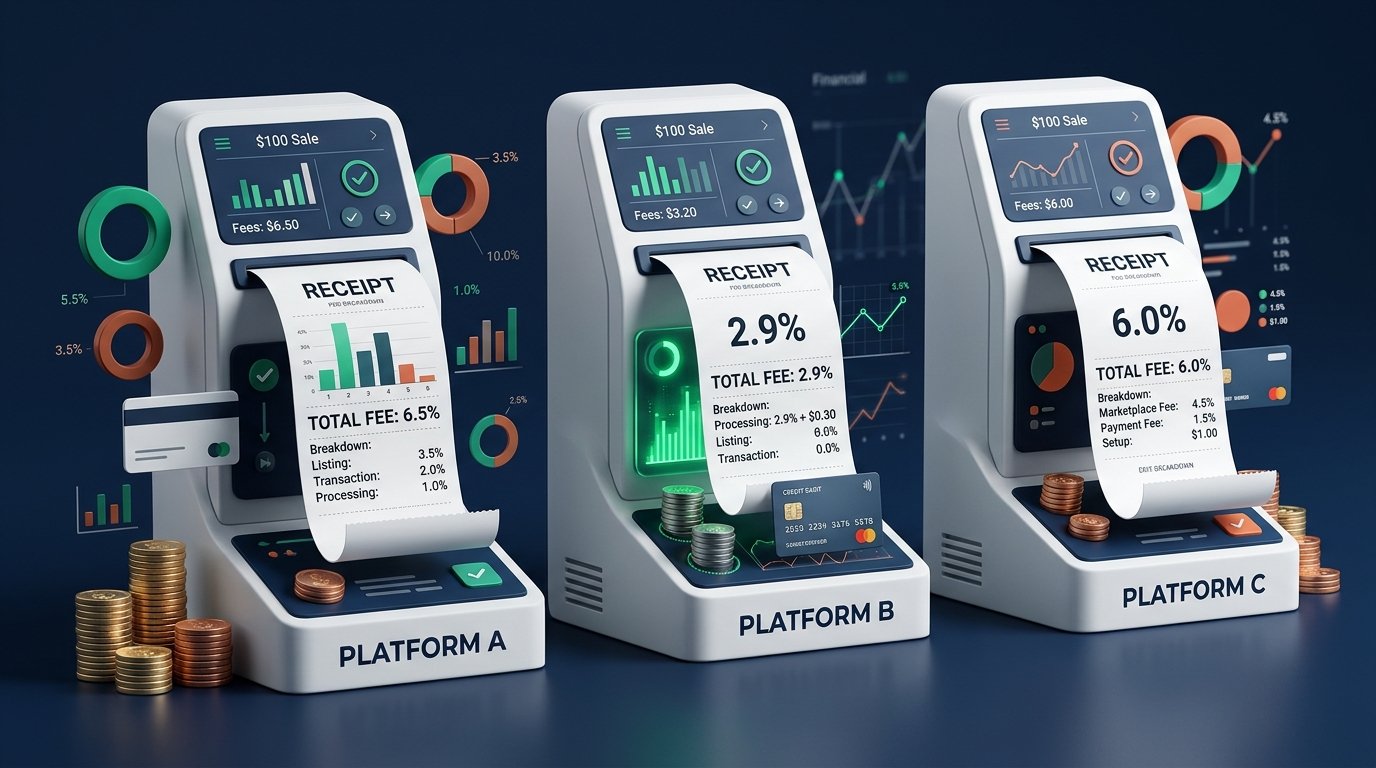
A customer clicks buy on a $40 order. Your dashboard flashes with a sale notification, dopamine hits, and on paper, you just earned revenue. But by the time platform tolls, merchant processing cuts, mandatory advertising splits, and shipping surcharges finish taking their bite, the amount landing in your checking account looks nothing like forty dollars.
Every e-commerce platform sells a comforting illusion: a neat headline transaction percentage printed in clean marketing typography. Etsy promotes its 6.5% transaction cut. Shopify touts 2.9% plus thirty cents on its Basic plan. TikTok Shop pitched sellers with low introductory cuts before quietly bumping standard rates to 6%. If you build your financial model on those sticker percentages, your business will slowly bleed cash through unbudgeted line items.
Most Viral Tool - Google Reviews Tool | SEO Audit Tool | ATS Resume Generator| Seller Profit & Tax Spreadsheet |
The Direct Answer: Your true cost of selling is never just the advertised transaction fee—it is your Effective Take Rate (ETR). On Etsy, your actual fee bite ranges between 9.5% and 13.5% for organic sales, skyrocketing to 22% to 26% if the sale originates through mandatory Offsite Ads. On Shopify, headline transaction fees are low (2.9% + $0.30), but fixed software subscriptions, essential third-party apps, and 100% self-funded customer acquisition costs push your real cost to 15%–30%+ at low volume, diluting down to 4%–7% only once you cross $10,000 in monthly revenue. On TikTok Shop, the 6% base commission is overshadowed by creator affiliate commissions (10%–20%), sample seeding losses, and promotional co-funding, producing an effective platform cut of 18% to 28%.
Key Takeaways
- The Discovery Tax vs. The Software Toll: Marketplaces (Etsy, TikTok Shop) charge variable percentage taxes on every dollar because they bring traffic. Standalone software (Shopify) charges fixed overhead up front and forces you to buy your own audience through paid ads or content.
- Shipping and tax are fee targets: Both Etsy and third-party payment processors assess percentage cuts against the total transaction value—including postage paid by the customer and sales tax collected.
- The $10,000 Etsy cliff: Crossing $10,000 in trailing 12-month sales triggers non-negotiable 12% Offsite Ads fees for the lifetime of your shop whenever Etsy’s external ads generate a sale.
- Shopify’s hidden app stack: Running a functional storefront requires email flows, reviews, and page builders that turn a $39/month Basic plan into a $150–$300/month recurring commitment before running a single advertisement.
- TikTok Shop’s affiliate dependency: Without offering 15% to 20% affiliate commissions and shipping free samples to creators, organic algorithm distribution on TikTok Shop flatlines.
The Three-Tier Tollgate Model: How Money Actually Leaves Your Account
To evaluate these platforms without getting blinded by marketing brochures, you must understand that e-commerce costs do not hit your balance sheet as a single deduction. Money exits through three distinct tollgates:
- Tier 1: Fixed Infrastructure Tolls. What it costs simply to exist on the platform each month, regardless of whether you process zero orders or ten thousand (e.g., Shopify monthly subscriptions, app retainers, custom domains, Etsy listing expiration cycles).
- Tier 2: Variable Settlement Cuts. What the platform and payment gateways extract at the exact millisecond of checkout (transaction percentages, flat gateway swipe fees, regulatory operating surcharges, and international currency conversions).
- Tier 3: Customer Acquisition & Retention Taxes. What you must spend to make the customer appear at checkout in the first place (Etsy Offsite Ads, TikTok creator affiliate revenue splits, sample seeding leakage, or Shopify Meta/Google ad spend).
When you aggregate all three tiers across a 30-day operating cycle, you arrive at your Effective Take Rate (ETR):
Effective Take Rate (ETR) % = (Total Monthly Platform Fees + Gateway Fees + App Costs + Acquisition Taxes) ÷ Gross Sales Revenue × 100
Trending Today- Earn $$$ FREE | Trending LIFE Quotes | HOT DEBATES | Autograph | FREE PAID Tools | Advertise FREE |
Let’s dismantle how each platform executes these deductions in the real world.
Etsy: The Frictionless Marketplace with Compounding Micro-Tolls
Etsy is built for velocity without technical friction. You create an account, upload photos, and instantly tap into over 90 million active buyers who arrive with purchase intent. But Etsy does not provide that audience out of benevolence; it monetizes every step of your catalog’s lifecycle.
Here is what happens to your cash on Etsy:
- The Listing & Auto-Renewal Fee ($0.20 per SKU): Every listing costs $0.20 to publish for a four-month window. If you sell an item with multiple quantities in stock, Etsy immediately auto-renews that listing and debits another $0.20 from your payment account upon sale. A store maintaining 500 active products pays $100 every four months just to keep the digital lights on.
- The 6.5% Transaction Fee (Item + Shipping + Gift Wrap): This is where many sellers miscalculate. Etsy does not take 6.5% of your item price; it takes 6.5% of the total charged to the buyer. If you sell a handcrafted cutting board for $40 and charge $15 for heavy parcel shipping, Etsy takes 6.5% of $55 ($3.58), not $40.
- Payment Processing (3% + $0.25 in the US): Like all merchant services, processing card payments carries interchange overhead. For US sellers, this adds another 3% of the total order value plus a flat twenty-five cents.
- Regulatory Operating Fees (0.25%–1.1% in select countries): In jurisdictions that introduced digital services taxes—including the UK, France, Italy, Spain, and Canada—Etsy passes these taxes straight to merchants as a separate fee levied on item price and shipping.
- The Offsite Ads Trap (12% to 15%): Etsy partners with Google, Facebook, Instagram, and Pinterest to advertise listings across the web. If a shopper clicks an Etsy ad and buys from your shop within 30 days, Etsy charges an additional 15% advertising fee on the complete order. If your shop has crossed $10,000 in gross sales over any trailing 12-month period, the fee drops to 12%—but participation becomes legally mandatory for the remaining life of your shop. You cannot turn it off.
The Real Scenario on Etsy: Imagine you sell an item for $35 with $7 shipping. The customer pays $42 total. If that buyer arrived organically through Etsy search:
- Listing renewal: $0.20
- Transaction fee (6.5% of $42): $2.73
- Payment processing (3% + $0.25 on $42): $1.51
- Total deduction: $4.44 (10.57% of gross revenue)
- Shopify Basic: $39/month (or $29/mo billed annually) + 2.9% + $0.30 per online card transaction.
- Shopify Plan: $105/month (or $79/mo billed annually) + 2.7% + $0.30 per transaction.
- Shopify Advanced: $399/month (or $299/mo billed annually) + 2.5% + $0.30 per transaction.
- Third-Party Gateway Penalty: If you choose not to use Shopify Payments (or live in an unsupported country) and connect Stripe or an external merchant account, Shopify penalizes you an additional 2.0% on Basic (1.0% on Shopify, 0.5% on Advanced) on top of what your merchant processor charges.
- Product reviews with rich snippet schema (Judge.me, Loox, or Okendo): $15–$50/month
- Automated email flows and abandoned cart recovery (Klaviyo or Omnisend): $30–$100+/month
- Custom landing page builder (Replo or PageFly): $29–$99/month
- Post-purchase upselling and cross-selling (ReConvert or CartHook): $15–$49/month
- Annual custom domain and premium theme: $14/year domain + $250–$380 one-time theme amortized
- Creator Affiliate Commissions (10% to 20%): The TikTok Shop algorithm does not push product listings sitting passively in a catalog. Sales are driven almost entirely through short-form video content and live-stream shopping. To convince affiliates and influencers to tag your product in their videos, you must offer an attractive commission. Most successful brands set their creator affiliate commission between 15% and 20%. When a creator drives a sale, TikTok automatically routes that percentage to the creator before depositing your funds.
- Sample Seeding Leakage: Getting 20 creators to produce videos requires sending 60 to 80 free samples. If each unit costs you $12 to manufacture and $5 to ship, sample distribution represents an upfront cash drain of $1,020. If half those creators never post a video, that capital is permanently unrecovered inventory loss that must be amortized into your order fees.
- Co-Funded Promotion Pressures: Participating in TikTok’s seasonal mega-campaigns (e.g., Black Friday, Summer Sales) frequently requires merchants to provide deep base discounts or co-fund platform coupons, eroding gross margin by an additional 5% to 15%.
- High Refund and Return Velocity: Impulse buying triggered by short-form video carries naturally higher buyer remorse. Return rates on TikTok Shop frequently run 2x to 3x higher than desktop web stores, leaving merchants absorbing two-way return postage and unsellable open-box merchandise.
- Gross collected: $56.00
- Listing renewal: -$0.20
- Transaction fee (6.5% of $56): -$3.64
- Payment fee (3% + $0.25 of $56): -$1.93
- Postage cost: -$5.50
- Product COGS: -$16.00
- Net Profit: $28.73
- Platform ETR: 10.3% ($5.77 fees)
- Gross collected: $56.00
- Amortized plan & apps ($150/mo): -$0.84
- Card fee (2.9% + $0.30 of $56): -$1.92
- Blended Meta CAC per order: -$14.00
- Postage cost: -$5.50
- Product COGS: -$16.00
- Net Profit: $17.74
- Platform Software ETR: 4.9% ($2.76)
- Gross collected: $56.00
- Platform commission (6% of $56): -$3.36
- Creator affiliate cut (15% of $50): -$7.50
- Sample & return reserve: -$1.50
- Postage cost: -$5.50
- Product COGS: -$16.00
- Net Profit: $22.14
- Platform & Creator ETR: 22.1% ($12.36)
- Calculating margins on item price rather than total settlement: Never budget your transaction fees against your $30 retail tag while ignoring your $8 customer shipping charge. Both Etsy and credit card gateways deduct percentages from the gross total. If you do not factor shipping into your fee model, your effective fee percentage jumps by 20% to 30%.
- Launching on Shopify before proving organic product-market fit: Committing to Shopify when generating less than $1,500 monthly locks you into fixed software retainers and forces you to fund 100% of your own traffic acquisition. If your ad creatives are unproven, software subscriptions will consume your working capital before you find traction.
- Failing to budget TikTok creator sample attrition: If you sell on TikTok Shop, your sample budget is not an administrative afterthought; it is Cost of Goods Sold. Treat sample losses as an operating expense tied directly to creator acquisition.
- Ignoring the lifetime lock of Etsy’s Offsite Ads: When your Etsy shop approaches $9,000 in annual revenue, monitor your growth pace carefully. Crossing $10,000 triggers non-negotiable 12% ad cuts permanently. Ensure your pricing structure can absorb a 22%+ effective platform bite before crossing that threshold.
- Using external payment gateways on Shopify unnecessarily: Bypassing Shopify Payments in favor of third-party processors triggers a 2.0% transaction penalty on Basic plans. Unless your business operates in high-risk categories unsupported by Shopify Payments, never hand Shopify an avoidable 2% margin haircut.
- Stage 1: Validation ($0 to $2,500 Monthly GMV) → Live on Marketplaces. Stay on Etsy or TikTok Shop. Absorb high variable transaction fees (10% to 22%) in exchange for zero fixed subscription overhead and immediate access to algorithmic search audiences. Use marketplace reviews to prove product-market fit.
- Stage 2: The Hybrid Funnel ($2,500 to $10,000 Monthly GMV) → Build the Bridge. Launch a lean Shopify store while keeping your marketplace shops fully active. Include high-converting branded packaging inserts, VIP care guides, and warranty registration QR codes in every marketplace package to guide first-time buyers toward repurchasing on your standalone Shopify store.
- Stage 3: Enterprise Scale ($10,000+ Monthly GMV) → Establish Shopify as the Retention Hub. At this scale, Shopify’s fixed software overhead drops below 5% of gross revenue. Use TikTok Shop and Etsy strictly as top-of-funnel customer acquisition channels, while driving all high-margin repeat orders, subscriptions, and wholesale accounts through your proprietary Shopify store.
Now consider that exact same transaction occurring via an Offsite Ad. Etsy tacks on 12% of the $42 ($5.04). Your total deductions surge to $9.48. Your effective take rate just spiked to 22.57%. If your net margin before platform fees was 30%, Etsy just walked away with three-quarters of your operational profit.
Shopify: The High-Autonomy Software Stack with Hidden Fixed Bloat
Shopify operates under an entirely different philosophy. It is not a marketplace; it is enterprise-grade commerce software rented to you on a monthly subscription. There is no central directory where millions of customers browse products. You own the domain, customer emails, pixels, and branding.
On paper, Shopify’s variable transaction fees look tantalizingly cheap compared to Etsy:
Here’s what most articles miss: Shopify’s advertised subscription is merely the chassis. To drive the car, you must purchase the engine from the Shopify App Store.
A standard e-commerce store requires basic functional capabilities that the default Shopify core does not provide out of the box:
Before you make a single sale, your fixed monthly overhead typically sits between $120 and $250 every month.
The Real Scenario on Shopify: If you generate $1,000 in monthly revenue across twenty-five $40 orders, your $39 subscription, $80 in app retainers, and $40.50 in credit card processing total $159.50. Your Effective Take Rate is 15.95%—and that is before budgeting a single dollar for paid traffic acquisition.
However, the math flips completely once you achieve volume. At $25,000 in monthly sales, fixed app costs and software subscriptions become negligible rounding errors. Your ETR on Shopify drops to 3.8%–4.5%. This is why scaling brands eventually migrate toward Shopify: its cost curve flattens as volume rises, whereas marketplace percentage cuts expand forever.
To accurately model your margins before investing capital, you can use our free reseller profit tracker generator to simulate platform deductions and net margins.
TikTok Shop: The Viral Distribution Engine with Creator and Logistics Surcharges
TikTok Shop represents the newest financial architecture in modern commerce. It marries algorithmic video entertainment with native in-app checkout. When TikTok launched the storefront in the US and UK, it heavily subsidized sellers with razor-thin introductory commissions (1.8% to 2% plus $0.30) and free shipping coupons to build supplier density.
Those subsidy days are over. The baseline platform fee has stepped up to a standard 6.0% commission per transaction across most consumer goods categories (with apparel and higher-risk categories climbing to 8%).
While a flat 6% commission (which conveniently bundles payment processing) appears competitive with Etsy, the true expenses of TikTok Shop hide inside its social distribution mechanics:
The Real Scenario on TikTok Shop: You sell a viral beauty product for $30. The platform takes its 6% cut ($1.80). The affiliate creator who posted the viral review takes a 15% commission ($4.50). You amortize $1.20 per order in sample costs and return leakage. Your total deductions reach $7.50—an Effective Take Rate of 25.0%.
Side-by-Side Architectural Breakdown: Where Every Cent Goes
To visualize the structural divergence between these three ecosystems, look at how their fee mechanics operate side-by-side across every operational layer:
| Fee Component | Etsy | Shopify (Basic Plan) | TikTok Shop |
|---|---|---|---|
| Monthly Platform Fee | $0 ($10/mo optional Plus) | $39/month ($29 billed annually) | $0 monthly software fee |
| Core Transaction Cut | 6.5% on (Item + Shipping) | 0% with Shopify Payments (2.0% with external gateways) | 6.0% standard (up to 8% in select niches) |
| Credit Card Processing | 3.0% + $0.25 (US domestic) | 2.9% + $0.30 per online card transaction | Bundled inside platform commission |
| Listing & Renewal Costs | $0.20 per listing / 4 months or auto-renew per sale | $0 (Unlimited products included) | $0 (Unlimited products included) |
| Discovery & Advertising | 12%–15% Offsite Ads (Mandatory at $10k+ volume) | 100% merchant-funded (Meta/Google Ads, SEO) | 10%–20% Creator Affiliate splits + Sample costs |
| Essential Tool Stack | Minimal ($0–$15/mo for third-party SEO tools) | $50–$200+/month (Klaviyo, Reviews, Page builders) | Minimal ($0–$30/mo for affiliate analytics tools) |
| Currency Conversion | 2.5% surcharge on cross-currency sales | Market rate + 1.5% (US) / 2.0% (International) | Varies by cross-border settlement region |
| Dispute / Chargeback Fee | Absorbed via purchase protection (if eligible) | $15 per formal dispute (refunded if won) | Handled in-app; strict buyer-friendly automated terms |
| Real Effective Take Rate (ETR) | 9.5%–13.5% (Organic) 22%–26% (Offsite Ads) |
15%–30%+ (at $1k/mo) 4%–6% (at $15k+/mo) |
18%–28% (with creator affiliate & samples) |
Real-World Case Study: Selling a $50 Product Across All Three Channels
Theory is clean; bank accounts are messy. Let’s compare an identical order across all three storefronts to see exact dollar distributions.
The Product: A handcrafted leather wallet priced at $50, with $6 flat-rate shipping charged to the buyer ($56 total checkout value). Cost of goods sold (COGS) is $16, and actual shipping label cost is $5.50.
Scenario A: Etsy (Organic Sale)
Scenario B: Shopify ($10k/mo Store)
Scenario C: TikTok Shop (Affiliate)
Notice the stark counter-intuition in this data: Shopify had the lowest platform toll ($2.76), but the lowest net profit ($17.74) because the seller had to pay Meta $14 to acquire the customer. Meanwhile, Etsy took more than double Shopify’s platform fees ($5.77), yet left the seller with the highest net profit ($28.73) because Etsy’s organic marketplace algorithms delivered the buyer for free.
Common Financial Mistakes That Quietly Drain Seller Capital
Over a multi-year operating horizon, margin leaks rarely come from major disasters; they come from persistent accounting errors. Watch for these five common mistakes:
Advanced Insights: The “Volume-to-Autonomy” Migration Framework
The central strategic question is not which platform is cheapest, but at what exact revenue threshold does software autonomy become mathematically superior to marketplace dependence?
The Three-Stage Lifecycle Framework
Frequently Asked Questions
Is Etsy genuinely more expensive than Shopify?
It depends entirely on your monthly sales volume. At low volumes (under $1,500 per month), Etsy is significantly cheaper because it charges no monthly software fee or mandatory app subscriptions. At high volumes (over $8,000 per month), Etsy becomes dramatically more expensive because its 6.5% transaction fee, 3% payment processing fee, and potential 12%–15% Offsite Ads fee take far more capital than Shopify’s flat $39 subscription and payment processing costs.
Does TikTok Shop charge a separate payment processing fee?
No. Unlike Shopify (which charges 2.9% + $0.30 via Shopify Payments) and Etsy (which charges 3% + $0.25 via Etsy Payments), TikTok Shop bundles merchant payment processing directly into its standard 6.0% platform commission fee.
Can I opt out of Etsy’s Offsite Ads program?
You can only opt out of Etsy Offsite Ads if your shop has generated less than $10,000 in gross sales across the preceding 365 days. Once your shop crosses the $10,000 threshold, you are automatically enrolled at a 12% advertising fee, and participation becomes permanent for the lifetime of your shop.
How much does a functional Shopify app stack cost per month?
While Shopify’s base plan costs $39 per month, a fully equipped commercial store requires third-party apps for email automation, customer reviews, page builders, and upsell funnels. A standard, lean app stack typically adds between $60 and $200 per month in additional recurring software fees.
Can I run storefronts on all three platforms simultaneously?
Yes. The most profitable multi-channel e-commerce brands operate across all three: leveraging TikTok Shop for viral top-of-funnel customer discovery, Etsy for capture of high-intent search shoppers, and Shopify as the branded flagship store where customer retention and repeat purchase margins are highest.
Final Insight
Your goal is not finding the storefront with the lowest headline percentage. Your goal is matching your business model’s margins to the platform’s cost curve. Marketplaces like Etsy and TikTok Shop charge steep variable percentages because they supply the audience; software platforms like Shopify charge flat software fees but require you to buy the audience yourself.
Audit your numbers through the lens of your Effective Take Rate. Know whether your business currently lacks traffic or margin—and pick the toll booth you are prepared to pay.